
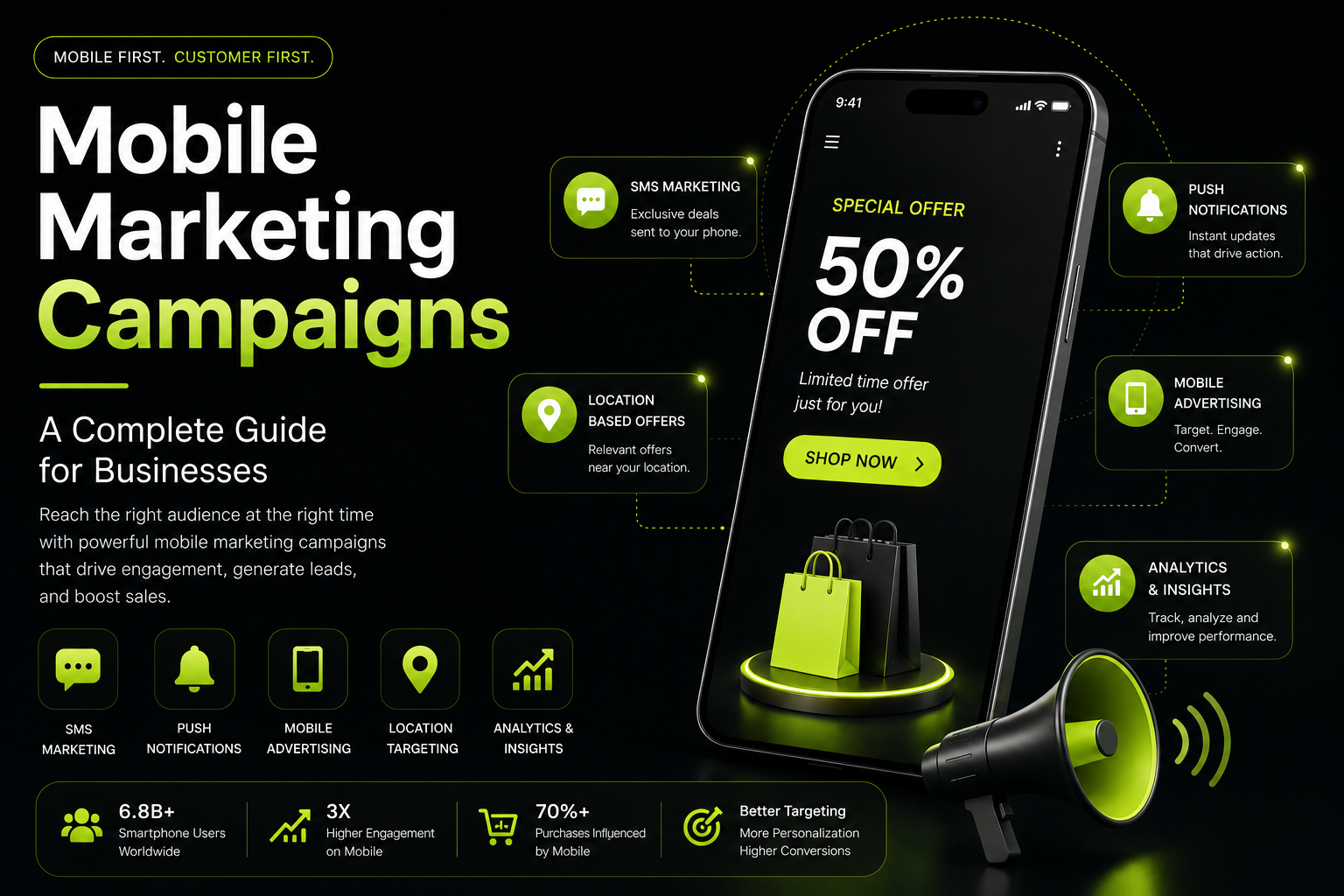
 Mobile phones have become an essential part of everyday life, making them one of the most powerful channels for reaching customers. From SMS messages and app notifications to mobile ads and social media, businesses can connect with their audience directly through their smartphones.
This is where mobile marketing campaigns come in. A well-planned mobile marketing campaign can increase brand awareness, engage customers, generate leads, and drive sales. Whether you run a small local business, an e-commerce store, or a growing brand, mobile marketing can help you reach potential customers at the right time and in the right place.
What Are Mobile Marketing Campaigns?
Mobile marketing campaigns are marketing activities designed specifically to reach and engage customers through mobile devices such as smartphones and tablets.
These campaigns can use different channels, including SMS, mobile apps, social media, mobile websites, push notifications, and mobile advertising. The goal is to deliver relevant content to customers at the right time and through the right mobile channel.
Unlike traditional marketing, mobile marketing allows businesses to communicate with customers in a more direct and personalized way. For example, a clothing brand can send a special discount to customers through SMS, while an online store can use push notifications to remind users about products left in their shopping carts.
Why Are Mobile Marketing Campaigns Important?
The majority of consumers spend a significant amount of time using their smartphones. This gives businesses an opportunity to communicate with customers wherever they are.
Some major benefits include:
Direct communication: Businesses can communicate with customers through personal devices.
Higher engagement: Mobile-friendly content can encourage users to interact with brands.
Better targeting: Campaigns can be customized based on customer interests, behavior, and location.
Quick responses: SMS, push notifications, and mobile ads can encourage immediate action.
Increased conversions: A convenient mobile experience can make it easier for customers to purchase products or services.
Cost-effective marketing: Many mobile marketing channels can be more affordable than traditional advertising.
Personalized experiences: Businesses can create messages based on individual customer preferences and behavior.
Measurable results: Digital platforms provide valuable data that businesses can use to measure campaign performance.
Types of Mobile Marketing Campaigns
Businesses can use different types of mobile marketing campaigns depending on their goals and target audience
1. SMS Marketing Campaigns
SMS marketing involves sending promotional messages, offers, reminders, or updates directly to customers’ phones. It can be useful for limited-time offers, appointment reminders, product launches, and special discounts.
For example, a salon could send an SMS reminding a customer about an upcoming appointment or offering a discount for their next booking.
Businesses should focus on sending useful and relevant messages rather than sending frequent promotional texts. Customers should also provide appropriate consent before receiving marketing messages.
2. Mobile App Marketing Campaigns
Businesses with mobile apps can use in-app promotions, personalized content, and app notifications to encourage users to return to the app and interact with the brand.
App marketing can be useful for e-commerce businesses, food delivery platforms, fitness applications, financial services, and entertainment brands.
Businesses can promote new features, recommend products, provide personalized offers, and encourage inactive users to return to the application.
3. Push Notification Campaigns
Push notifications appear directly on a user’s mobile device. Businesses can use them to announce new products, remind customers about abandoned carts, share offers, or provide important updates.
A well-timed push notification can encourage users to revisit an app or website. However, sending too many notifications can annoy users and may cause them to disable notifications or uninstall an app.
4. Mobile Advertising Campaigns
Mobile advertising includes advertisements displayed on mobile websites, apps, search engines, and social media platforms.
Businesses can target specific audiences based on factors such as interests, demographics, online behavior, and location. Mobile advertisements can include display ads, video ads, social media ads, search ads, and native advertising.
5. Location-Based Marketing Campaigns
Location-based campaigns use a customer’s geographic location to deliver relevant promotions or information.
For example, a restaurant could promote a lunch offer to customers who are nearby. Similarly, a retail store could use location-based advertising to attract potential customers in the surrounding area.
This type of marketing can be particularly useful for local businesses that depend on customers visiting a physical location.
Mobile Marketing Campaigns and Social Media
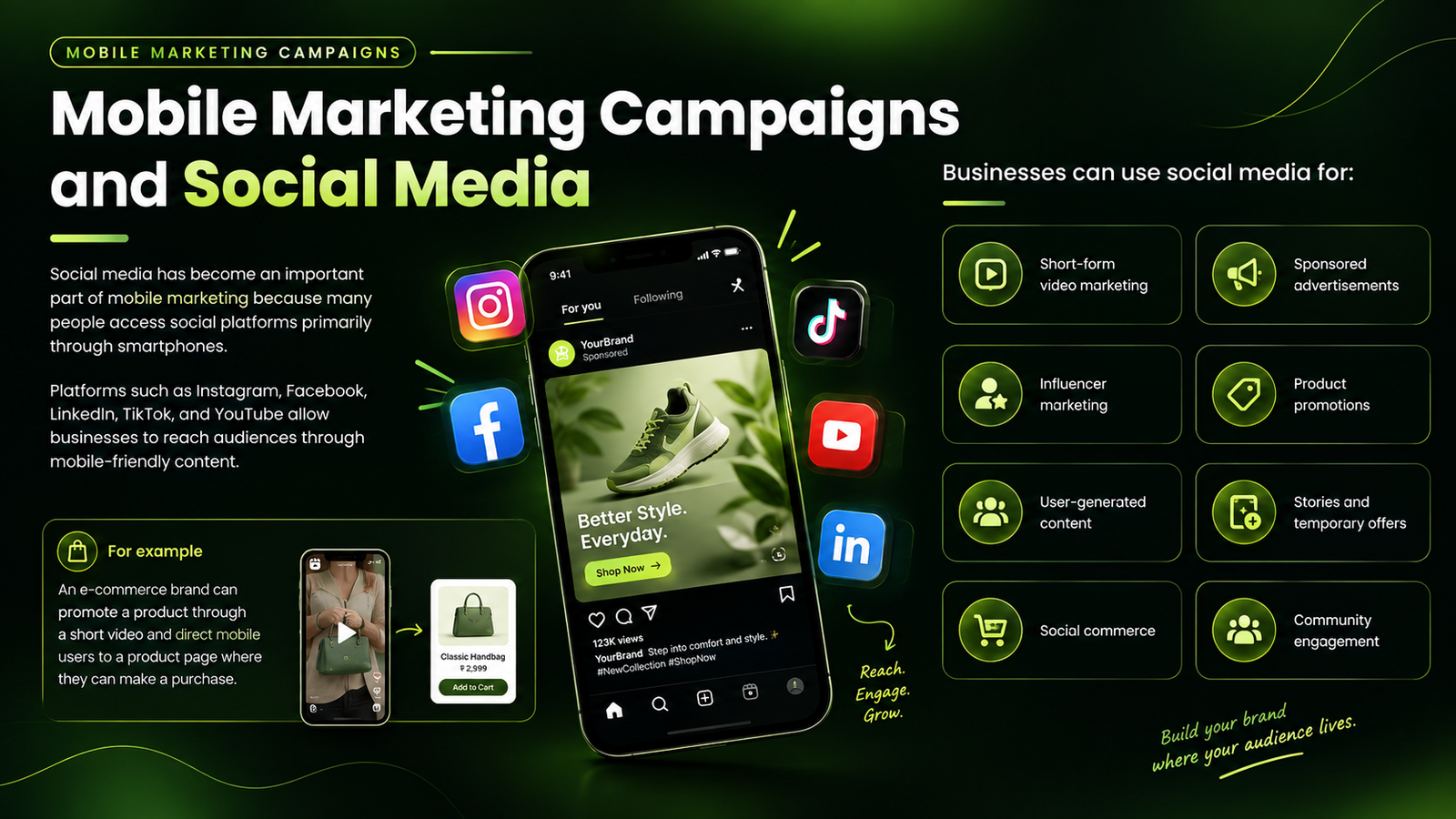
Social media has become an important part of mobile marketing because many people access social platforms primarily through smartphones.
Platforms such as Instagram, Facebook, LinkedIn, TikTok, and YouTube allow businesses to reach audiences through mobile-friendly content.
Businesses can use social media for:
Short-form video marketing
Sponsored advertisements
Influencer marketing
Product promotions
User-generated content
Stories and temporary offers
Social commerce
Community engagement
For example, an e-commerce brand can promote a product through a short video and direct mobile users to a product page where they can make a purchase.
How to Create an Effective Mobile Marketing Campaign
Creating a successful campaign requires more than simply sending promotional messages. Businesses should focus on providing relevant and valuable experiences.
Step 1: Define Your Goal
Start by identifying what you want to achieve. Your goal could be increasing sales, generating leads, promoting an app, increasing website traffic, or improving customer engagement.
A clear objective makes it easier to select the right platform and measure the success of your campaign.
Step 2: Understand Your Audience
Identify your target customers and understand their interests, needs, and mobile behavior. This helps you create messages that are more relevant to them.
Consider factors such as age, location, interests, purchasing behavior, and previous interactions with your brand.
Step 3: Segment Your Audience
Instead of sending the same message to every customer, divide your audience into relevant groups.
For example, an online fashion store could create separate groups for new customers, repeat customers, inactive customers, and customers who have shown interest in specific product categories.
Audience segmentation can make mobile marketing campaigns more relevant and improve engagement.
Step 4: Choose the Right Mobile Channel
Select the channel that best matches your audience and campaign objective.
For example, SMS may work well for time-sensitive offers, while push notifications may be more suitable for app users. Social media advertising can be useful for reaching new audiences, while email can help nurture existing customers.
Step 5: Create Mobile-Friendly Content
Keep your content short, clear, and easy to read on smaller screens. Use compelling headlines, simple visuals, and clear calls to action.
If you are directing users to a website, make sure the landing page loads quickly and is easy to navigate on mobile devices.
Step 6: Personalize Your Campaign
Personalization can make mobile marketing more relevant. Businesses can use customer preferences, previous purchases, or behavior to provide more targeted messages.
Instead of sending a generic message such as “Check out our products,” a business could recommend products based on what a customer previously viewed or purchased.
Step 7: Create a Strong Call to Action
Every campaign should have a clear purpose and a simple call to action.
Examples include:
Shop Now
Book Now
Download the App
Get Your Offer
Learn More
Sign Up
Claim Your Discount
A clear CTA tells customers exactly what action they should take next.
Step 8: Test Before Launching
Testing is an important part of successful mobile marketing campaigns. Businesses can test different headlines, images, offers, CTAs, and message formats.
A/B testing can help determine which version produces better engagement or conversions.
Step 9: Measure Campaign Performance
Track important metrics such as click-through rates, conversion rates, engagement, app installs, and return on investment.
These insights can help you understand what is working and improve future campaigns.
Personalization in Mobile Marketing
One of the biggest advantages of mobile marketing is the ability to personalize communication.
Customers are more likely to respond to content that is relevant to their needs and interests. Businesses can personalize campaigns using information such as purchase history, browsing behavior, location, preferences, and engagement.
For example, an online store could send a personalized notification to a customer about a product related to something they previously purchased.
Personalization does not necessarily mean using a customer’s name. It can also mean delivering the right offer, product recommendation, or message based on their behavior.
Mobile Marketing and Mobile SEO
A strong mobile marketing strategy should also consider search engine optimization. Customers often use smartphones to search for products, services, businesses, and information.
Businesses should ensure that their websites are:
Mobile-friendly
Fast-loading
Easy to navigate
Simple to read on smaller screens
Optimized for relevant search terms
Supported by clear calls to action
A poor mobile experience can cause visitors to leave before completing an action. Therefore, mobile SEO and mobile marketing should work together to create a smooth customer journey.
Examples of Mobile Marketing Campaigns
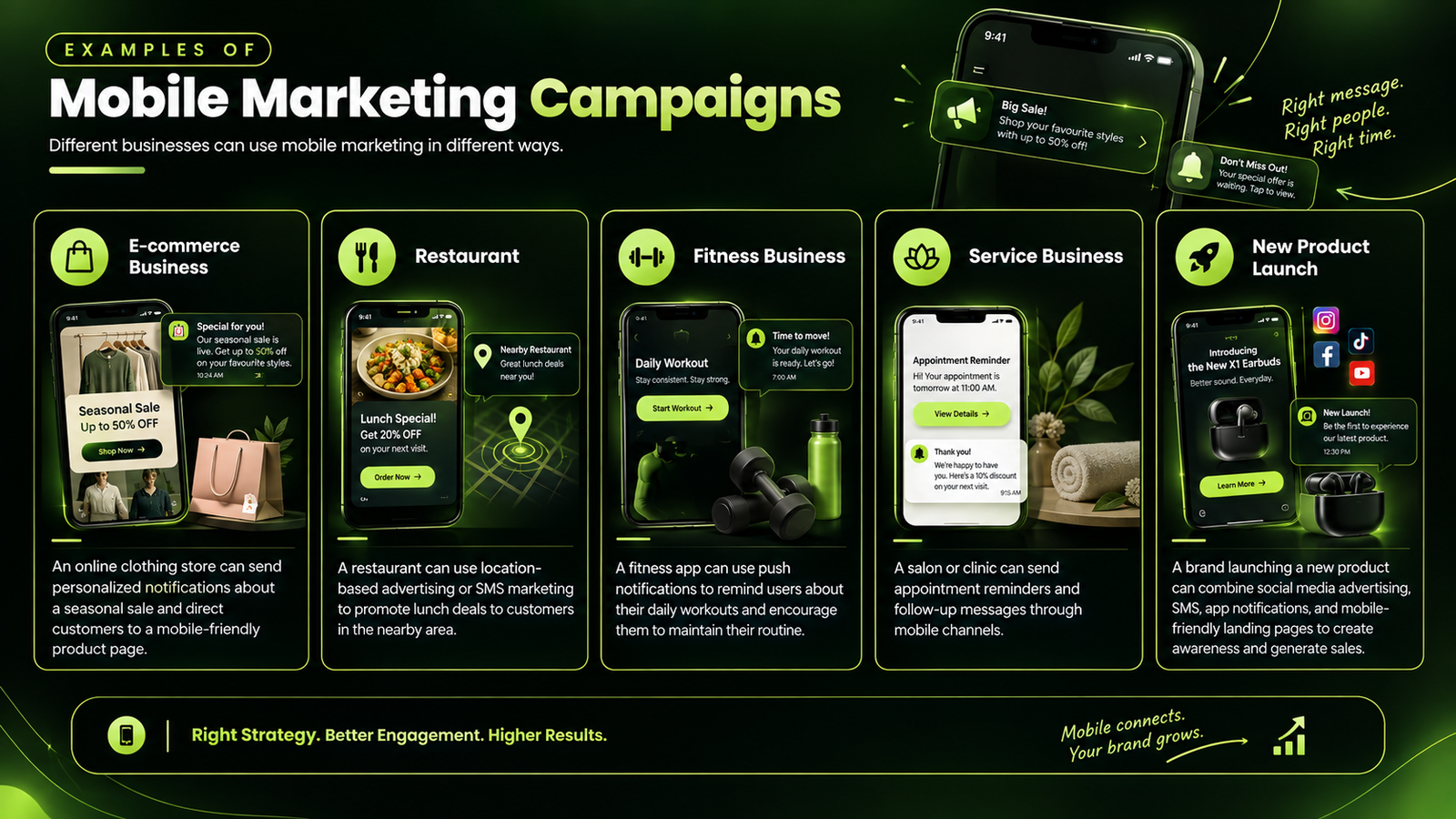
Different businesses can use mobile marketing in different ways.
E-commerce Business
An online clothing store can send personalized notifications about a seasonal sale and direct customers to a mobile-friendly product page.
Restaurant
A restaurant can use location-based advertising or SMS marketing to promote lunch deals to customers in the nearby area.
Fitness Business
A fitness app can use push notifications to remind users about their daily workouts and encourage them to maintain their routine.
Service Business
A salon or clinic can send appointment reminders and follow-up messages through mobile channels.
New Product Launch
A brand launching a new product can combine social media advertising, SMS, app notifications, and mobile-friendly landing pages to create awareness and generate sales.
Key Metrics to Measure Mobile Marketing Campaigns
Measuring performance is essential for understanding whether a campaign is achieving its goals.
Some important metrics include:
Click-Through Rate
Click-through rate measures the percentage of people who click on a link or advertisement after seeing it.
Conversion Rate
Conversion rate shows how many users completed the desired action, such as purchasing a product, submitting a form, or signing up for a service.
Engagement Rate
Engagement can include clicks, interactions, app activity, social media engagement, and other customer actions.
App Installs
For app-focused campaigns, tracking new installations can help determine whether advertising efforts are attracting new users.
Customer Acquisition Cost
Customer acquisition cost helps businesses understand how much they are spending to acquire each new customer.
Return on Investment
ROI helps determine whether the revenue generated by a campaign justifies the amount spent on marketing.
Common Mobile Marketing Mistakes to Avoid
Even well-planned mobile marketing campaigns can fail when businesses overlook the customer experience.
Some common mistakes include:
Sending too many promotional messages
Using content that is difficult to read on mobile devices
Creating slow-loading landing pages
Using unclear calls to action
Sending irrelevant offers
Ignoring customer preferences
Not testing campaigns before launch
Failing to track results
Ignoring privacy and consent requirements
The goal should not simply be to reach as many people as possible. The focus should be on reaching the right audience with the right message at the right time.
Best Practices for Mobile Marketing Campaigns
To make mobile marketing campaigns more effective, businesses should:
Keep messages concise and easy to understand.
Make websites and landing pages mobile-friendly.
Use clear calls to action.
Avoid sending too many notifications or messages.
Personalize content whenever possible.
Test different messages and formats.
Respect customer privacy and obtain appropriate consent.
Analyze campaign performance regularly.
Segment audiences based on relevant customer behavior.
Provide genuine value through offers, information, or useful content.
Future of Mobile Marketing
Mobile marketing continues to evolve as technology and consumer behavior change. Businesses are increasingly using automation, artificial intelligence, personalization, short-form video, and data-driven targeting to improve customer experiences.
Emerging technologies can help brands create more relevant interactions across mobile devices. AI-powered recommendations, automated messaging, conversational chatbots, and personalized advertising are examples of how technology can support modern marketing strategies.
However, successful mobile marketing will continue to depend on relevance and customer experience. Businesses that understand their audience and provide useful content are more likely to build long-term relationships.
Conclusion
Mobile marketing campaigns provide businesses with a direct and flexible way to connect with their customers. Whether through SMS, mobile apps, push notifications, mobile advertising, social media, or location-based marketing, businesses can create personalized experiences that encourage customers to take action.
A successful mobile marketing campaign starts with a clear goal, a strong understanding of the target audience, and the right mobile channel. Businesses should also focus on mobile-friendly content, personalization, audience segmentation, and measurable results.
By combining relevant content with careful targeting and performance analysis, businesses can build stronger customer relationships, increase engagement, generate leads, and achieve better marketing results.
As smartphone usage and mobile technology continue to evolve, mobile marketing will remain an important part of a successful digital marketing strategy. Businesses that make mobile experiences simple, useful, and relevant can create meaningful connections with customers and turn mobile interactions into valuable business opportunities.