
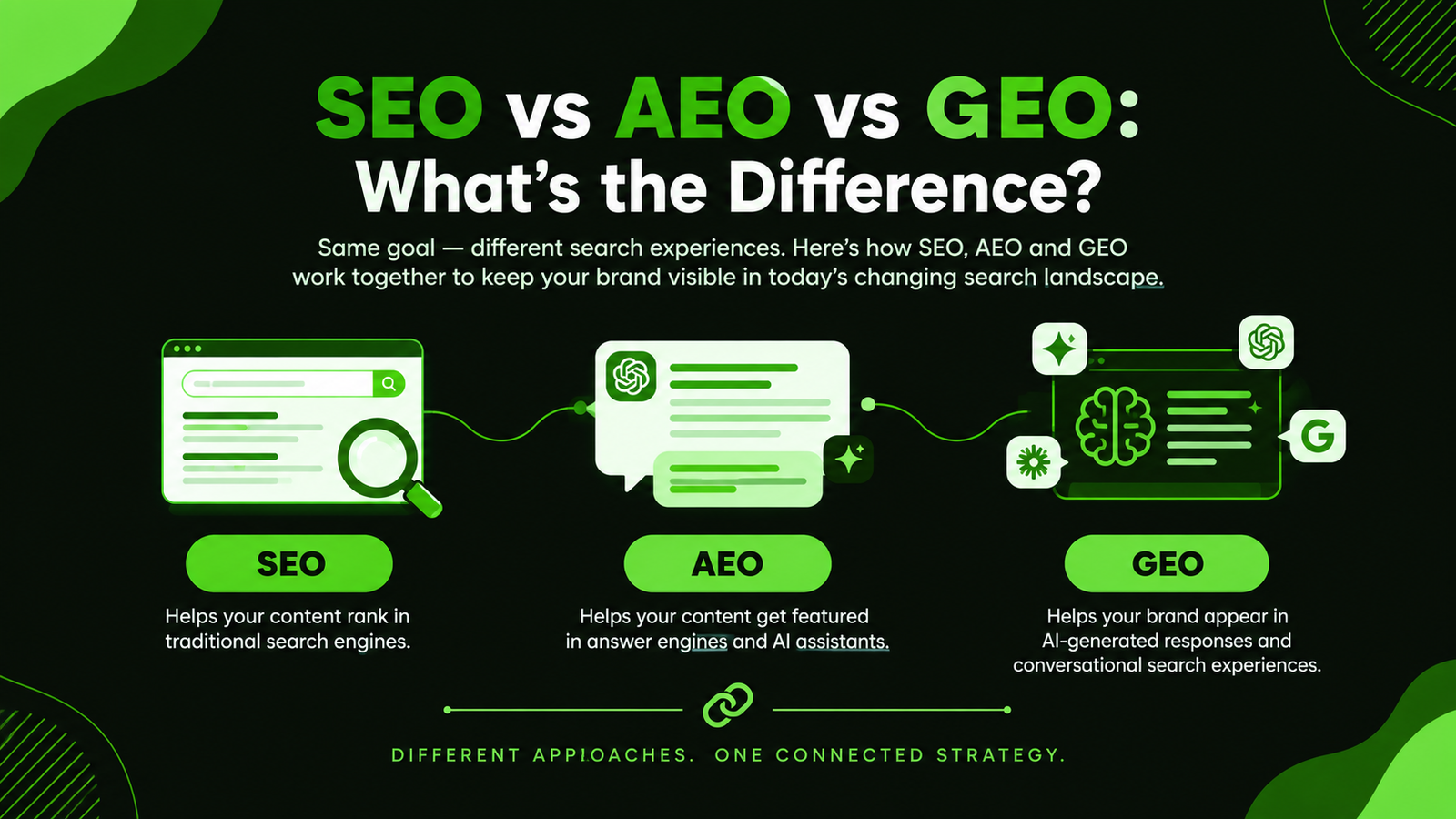
Search is changing rapidly. People are no longer relying only on traditional search engines to find information, products, and services. They are also using AI-powered tools and answer-focused search experiences to get direct, conversational responses.
For businesses, this means simply ranking on a traditional search engine may no longer be enough. Brands need to think about how their content can appear in search results, answer engines, and AI-generated responses.
This is where SEO, AEO, and GEO come into the picture.
Although these three approaches have different goals, they are closely connected. Understanding SEO vs AEO vs GEO can help businesses create content that remains visible across traditional search and emerging AI-powered search experiences.
What Is SEO?
SEO (Search Engine Optimization) is the process of improving a website and its content so that it can appear more prominently in traditional search engine results.
Search engines analyze many signals to understand which pages are relevant to a user’s search. SEO helps businesses make their websites easier for search engines to understand while also providing useful experiences for visitors.
SEO commonly involves:
Keyword research
On-page optimization
Technical SEO
Content optimization
Internal linking
Website performance
Backlink building
Local SEO
Image optimization
Search intent optimization
For example, if someone searches for “best freelance digital marketer in Kerala,” a business offering digital marketing services would want its website to appear prominently for that search.
A strong SEO strategy focuses on understanding what people search for, why they search for it, and how a website can provide the most useful answer.
What Is AEO?
AEO (Answer Engine Optimization) focuses on optimizing content so that it can provide direct answers to users’ questions.
Traditional search often gives users a list of webpages. Answer-focused experiences aim to provide a concise answer to the question itself.
AEO is particularly relevant for question-based searches such as:
What is digital marketing?
How does SEO work?
What is UGC marketing?
How can small businesses use social media marketing?
What is the difference between SEO and AEO?
To support AEO, content should be structured clearly and answer important questions directly.
Useful AEO practices include:
Answering questions clearly
Using descriptive headings
Creating FAQ sections
Providing concise definitions
Structuring information logically
Understanding search intent
Using relevant supporting information
Making content easy to interpret
The goal isn’t simply to rank a webpage. It is to make the information useful enough to be selected as an answer.
What Is GEO?
In the context of modern search marketing, GEO (Generative Engine Optimization) refers to optimizing content so that it has a better chance of being understood, referenced, or surfaced by generative AI search experiences.
AI-powered search tools can synthesize information from multiple sources and provide conversational responses instead of simply presenting a traditional list of links.
For businesses, this creates a new visibility opportunity.
Instead of only asking:
“How do I rank on Google?”
marketers may also need to consider:
“How can my brand become a useful and credible source for AI-generated answers?”
GEO focuses on factors such as useful information, topical relevance, clear structure, credibility, original insights, and content that can be easily understood and synthesized by AI systems.
SEO vs AEO vs GEO: The Main Difference
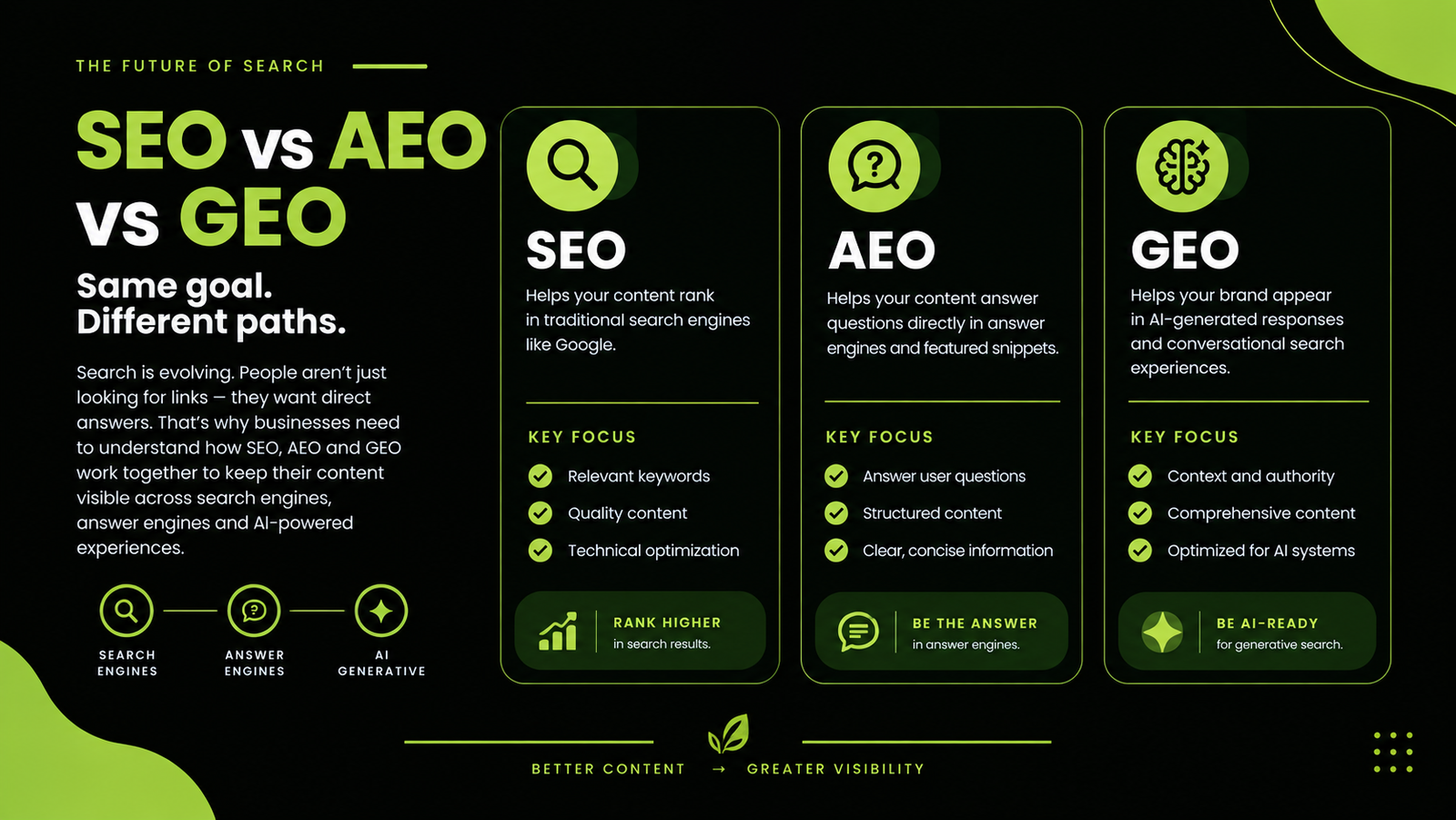
The simplest way to understand SEO vs AEO vs GEO is to look at what each approach is primarily trying to achieve.
| Approach | Main Focus | Main Goal |
|---|---|---|
| SEO | Search engines | Improve visibility in traditional search results |
| AEO | Answers | Provide direct answers to user questions |
| GEO | Generative AI search | Improve visibility within AI-generated responses |
These approaches aren’t replacements for one another.
Instead, they can work together as part of a broader search visibility strategy.
SEO vs AEO
SEO and AEO overlap considerably, but their primary objectives are different.
Traditional SEO often focuses on helping a webpage rank for relevant searches. AEO focuses more specifically on helping content answer a question directly.
For example, imagine a blog titled:
“What Is Content Marketing?”
An SEO strategy might focus on optimizing the page for keywords such as:
content marketing
content marketing strategy
content marketing examples
An AEO approach would additionally structure the article around questions such as:
What is content marketing?
Why is content marketing important?
What are the different types of content marketing?
How does content marketing work?
The strongest approach combines both.
You can create a page that is optimized for search engines while also providing clear answers to the questions users are asking.
SEO vs GEO
The difference between SEO vs GEO becomes more noticeable when looking at how information is presented.
SEO generally focuses on increasing a webpage’s visibility within search results.
GEO focuses on making content useful and understandable within generative search environments.
For example, someone might search for:
“Best digital marketing strategies for a small business.”
A traditional search experience may provide a collection of webpages.
A generative search experience may instead summarize several sources and provide a conversational response.
For a business, being visible in both environments can be valuable.
This means content should not be created solely around keyword repetition. It should provide meaningful information, demonstrate expertise, and cover a topic comprehensively.
AEO vs GEO
AEO vs GEO is another important comparison.
AEO is primarily concerned with providing direct answers to questions, while GEO focuses on visibility within generative AI-powered search experiences.
For example, an AEO-focused article might directly answer:
“What is local SEO?”
with a concise definition followed by supporting information.
A GEO-focused strategy may go further by creating comprehensive, trustworthy content around local SEO that an AI system can understand, summarize, and potentially reference when responding to related queries.
There is considerable overlap between the two. Clear answers are useful for both answer engines and generative AI systems.
Why SEO, AEO and GEO Matter for Businesses
Search behavior is becoming more diverse.
A potential customer might discover a business through:
A traditional Google search
A featured search result
A question-based search
An AI-powered search experience
Social media search
YouTube
Online reviews
Local search results
A recommendation from an AI assistant
This means businesses need to think beyond a single search platform.
A strong SEO, AEO and GEO strategy can help businesses build visibility across different types of search experiences.
The objective is not to optimize for every platform separately. Instead, businesses should create high-quality content that is useful to both people and the systems helping people discover information.
How SEO, AEO and GEO Work Together
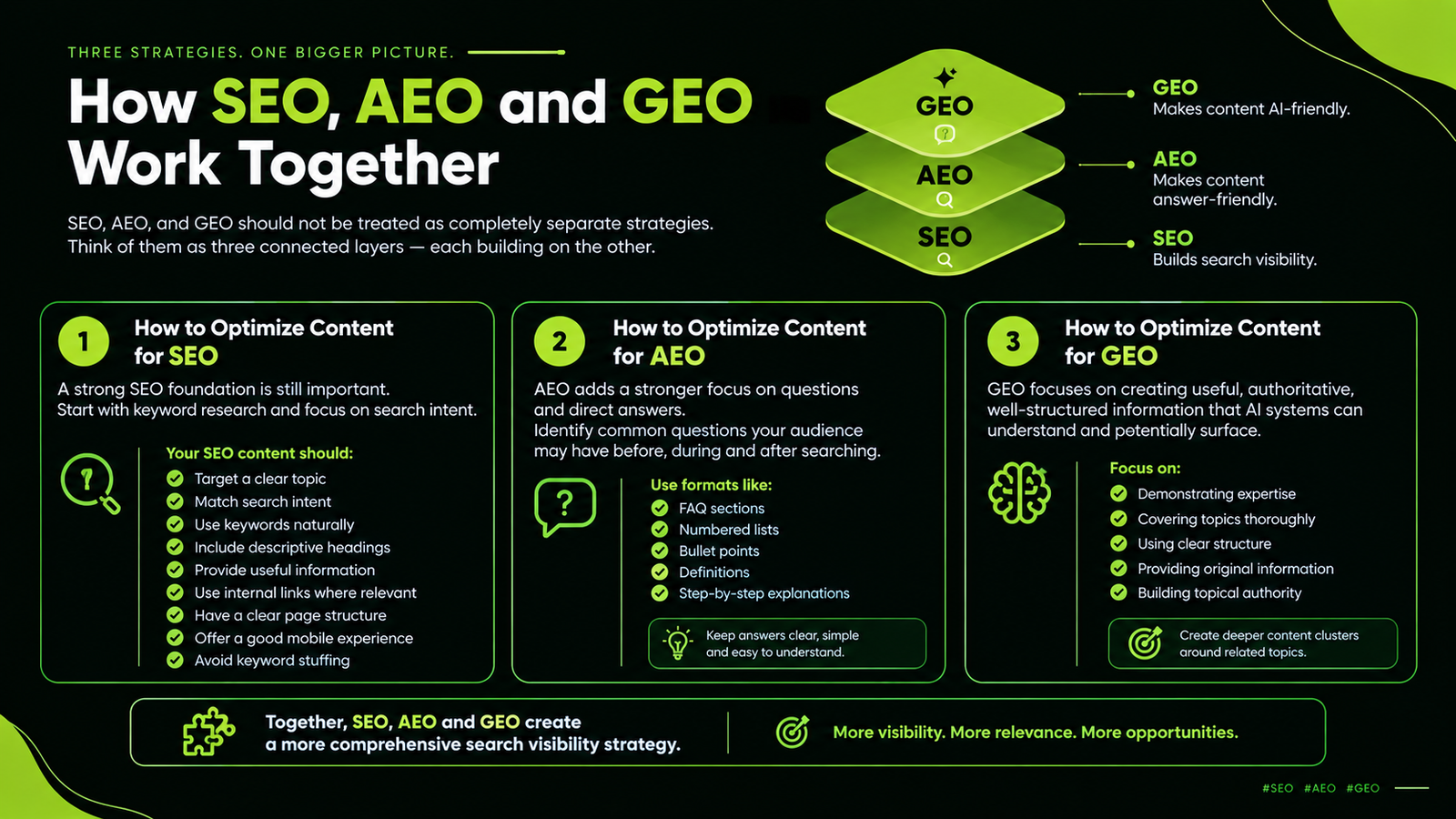
SEO, AEO, and GEO should not be treated as completely separate marketing strategies.
Think of them as three connected layers.
SEO Builds Search Visibility
SEO helps search engines discover, understand, and rank your content.
It creates the foundation through:
Technical optimization
Keywords
Search intent
Content
Internal links
Website structure
Authority
AEO Makes Content Answer-Friendly
AEO adds a stronger focus on questions and direct answers.
Instead of writing an article only around a keyword, you consider the questions someone may ask before, during, and after searching for that topic.
GEO Makes Content AI-Friendly
GEO focuses on creating useful, authoritative, well-structured information that can be understood and potentially surfaced within generative search experiences.
Together, these approaches create a more comprehensive search visibility strategy.
How to Optimize Content for SEO
A strong SEO foundation is still important.
Start with keyword research to understand what your audience is searching for. However, don’t focus solely on search volume. Consider search intent and whether the keyword is actually relevant to your business.
Your SEO content should:
Target a clear topic
Match search intent
Use keywords naturally
Include descriptive headings
Provide useful information
Use internal links where relevant
Have a clear page structure
Offer a good mobile experience
Avoid unnecessary keyword stuffing
The objective should be to create content that satisfies the searcher’s needs rather than simply inserting keywords repeatedly.
How to Optimize Content for AEO
To improve your Answer Engine Optimization approach, start by identifying common questions related to your topic.
For example, if your main topic is “social media marketing,” potential questions include:
What is social media marketing?
Why is social media marketing important?
Which social media platform is best for businesses?
How much does social media marketing cost?
How can a small business use social media?
Answer these questions clearly and place them under relevant headings.
You can also use FAQ sections, numbered lists, bullet points, definitions, and step-by-step explanations to make information easier to understand.
Avoid unnecessarily complicated answers when a simple explanation will do.
How to Optimize Content for GEO
Generative AI systems need useful information to produce useful responses.
A practical GEO strategy therefore starts with content quality.
Focus on:
1. Demonstrating Expertise
Create content that shows genuine knowledge of your subject.
Instead of writing generic statements, provide practical explanations, examples, processes, comparisons, and original insights.
2. Covering Topics Thoroughly
A comprehensive article can answer several related questions within one topic.
For example, an article about SEO can cover keyword research, technical SEO, on-page optimization, content strategy, and measurement.
3. Using Clear Structure
Organize information using:
H2 headings
H3 subheadings
Lists
Tables
Short paragraphs
Definitions
Examples
FAQs
Clear structure helps readers navigate content and makes complex information easier to understand.
4. Providing Original Information
Generic content is everywhere.
Adding original observations, examples, case studies, data, experiences, or unique perspectives can make your content more valuable.
5. Building Topical Authority
Instead of publishing one article about a subject and moving on, create related content around the same topic.
For example, a digital marketing website could create a content cluster around SEO:
What Is SEO?
Keyword Research Guide
On-Page SEO
Technical SEO
Local SEO
SEO vs AEO vs GEO
SEO Mistakes to Avoid
This creates deeper coverage of the subject.
Do You Need SEO, AEO or GEO?
The answer is all three can be valuable.
You don’t necessarily need three completely separate strategies.
Instead, start with strong SEO fundamentals and build AEO and GEO principles into your content creation process.
For example, when writing a blog post, you can:
Research the primary keyword.
Understand the user’s search intent.
Identify related questions.
Create a clear content structure.
Answer important questions directly.
Include relevant examples.
Add original insights.
Optimize the page technically.
Build internal links to related content.
Keep the content useful and easy to understand.
This approach allows one well-created article to serve multiple search experiences.
Common Mistakes When Optimizing for SEO, AEO and GEO
While optimizing content, businesses can easily focus too much on algorithms and forget about the actual reader.
Some common mistakes include:
Keyword stuffing
Writing purely for search engines
Creating thin content
Copying information from competitors
Using generic AI-generated content without adding value
Ignoring search intent
Making answers unnecessarily complicated
Creating clickbait headlines
Publishing content without fact-checking
Neglecting website usability
Search optimization should support the user experience rather than damage it.
A page filled with keywords but lacking useful information is unlikely to provide lasting value.
The Future of Search Optimization
The search landscape is moving toward more conversational and personalized experiences.
People increasingly expect search tools to understand context rather than simply match individual keywords.
This means marketers need to think beyond traditional keyword rankings.
The future of search is likely to involve a combination of:
Traditional search
Answer-based search
Generative AI
Voice search
Visual search
Social search
Local search
For businesses, this creates both challenges and opportunities.
The brands that consistently publish useful, trustworthy, well-structured content can build visibility across multiple discovery channels.
SEO vs AEO vs GEO: Which One Should You Focus On?
There isn’t one universal winner in the SEO vs AEO vs GEO comparison.
SEO remains important for traditional search visibility.
AEO helps businesses provide clear answers to specific questions.
GEO focuses on visibility within emerging generative AI search experiences.
Rather than choosing only one, businesses should combine the strengths of all three.
A strong strategy starts with SEO fundamentals, incorporates answer-focused content, and creates authoritative information that can work across AI-powered search experiences.
Conclusion
Understanding SEO vs AEO vs GEO is becoming increasingly important for modern digital marketers.
SEO focuses on improving visibility in traditional search results. AEO focuses on providing direct and useful answers to questions. GEO focuses on improving the chances of content and brands being surfaced or referenced in generative AI search experiences.
Although the terminology and search technologies continue to evolve, one principle remains important: create genuinely useful content for your audience.
Research what people want to know, answer their questions clearly, provide meaningful information, demonstrate expertise, and make your content easy to understand.
Instead of treating SEO, AEO, and GEO as competing strategies, businesses can use them together to build a stronger and more adaptable search visibility strategy.
As search continues to evolve, the goal isn’t simply to rank higher. It’s to become a useful source of information wherever your audience is searching.